
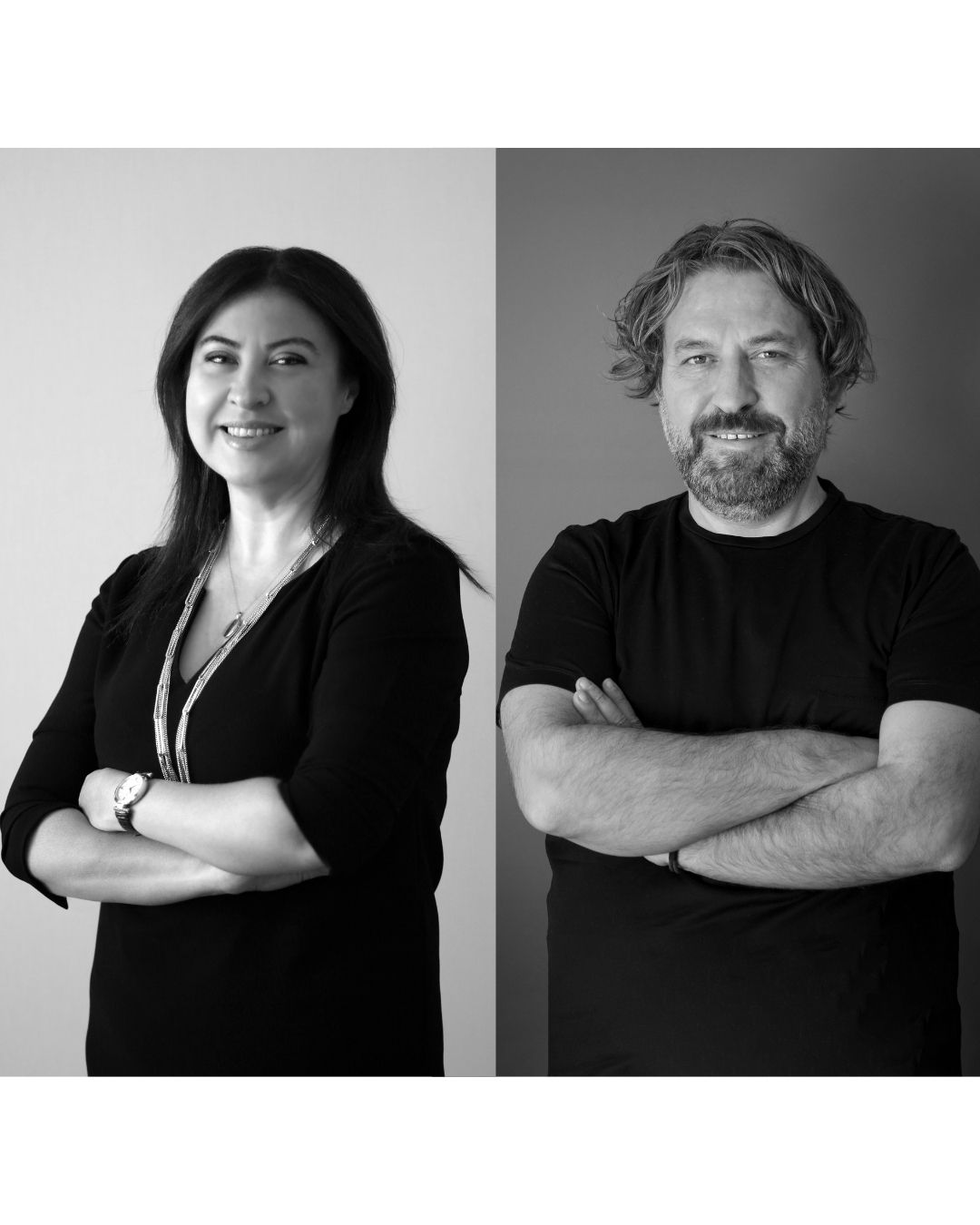
First of all, could you tell us a bit about yourself and the founding story of Ulema & Ulema Architecture? What are the core values that shape your design approach?
Hello, I am Dürrin Ulema, an architect. Together with my husband and partner, Necdet Ulema, we founded Ulema & Ulema Architecture Ltd. in 1996. We are both graduates of the Faculty of Architecture at İzmir Dokuz Eylül University. After graduation, I completed my master’s degree in building construction management at Istanbul Technical University.
My professional life actually began while I was still at university. When I reached my final year, I stepped into the professional world by working on interior design projects and applications. Necdet, in addition to his mandatory internships, worked in architectural offices every summer, gaining both office and construction site experience. Throughout our academic years, we were actively involved in various offices, and by the time we graduated, we already had a solid foundation of professional practice.
The idea of opening an office was not initially planned; it developed organically when we took on a qualified project that needed to be completed in a short time. Our first project included both design and implementation. With the contribution of the knowledge I gained during my master’s studies, our work later continued in this direction: project + implementation or project + supervision. We have always been involved in the implementation phase and have closely followed the process until the completion of our projects.
The most important characteristic of Ulema & Ulema Architecture is its user-oriented design approach. Rather than highlighting the building or the architect, we prioritize producing structures that are in harmony with their environment and are truly sustainable.
When we look at your projects, we see works of different scales and functions. What are the main criteria that guide you when starting a project, and how does your design process progress?
We have designed projects in very diverse built environments and functions. These include horse farms, dairy farms, residences of different scales, factories, and workplaces. In addition, we have carried out many restorations of historic buildings within the scope of civil architecture. In 2008, we received the İzmir Metropolitan Municipality Respect for Historical Environment Award for the restoration of a masonry stone building. Currently, we are also working on a synagogue restoration project.
We consider this diversity to be the greatest richness of our office. Each project is handled within its own context, and solutions specific to that context are developed.
In our residential projects in İzmir and its surrounding districts—Urla, Çeşme, Foça, Mordoğan, and Sarnıçköy—we frequently use natural stone. In our designs, we treat natural stone not as a cladding material but as a masonry wall. Our aim is to reveal stone, wood, and concrete as they are, without concealing them.
Material selection appears to play an important role in your architectural practice. In this context, what does natural stone mean to you, and how does it find its place in your projects?
In addition to the natural building stones we use in constructing the structure itself, we also frequently use natural stone and marble in interiors in a way that complements the design. In fact, we have many projects in which fired clay and ceramics are not used at all.
We use stone with different techniques in floor coverings, countertops, fireplaces, terrace claddings, and wet areas. Especially in bathrooms, sinks carved from solid marble blocks add a unique value to the project. The contribution of such applications to the design is very important to us.
Türkiye is a geography rich in natural stone diversity. What is your approach to using Turkish natural stones in your projects? How do you evaluate the unique values these materials add to design?
Our priority is always to use local materials. Whenever possible, we prefer the natural stone of the region where we carry out the project.
A significant part of my childhood was spent in the Tire district of İzmir. Tire is an important cultural center that has existed since the period of the Anatolian beyliks and stands out especially with its masonry stone structures built by Greek craftsmen. I grew up experiencing different uses of stone through window jambs, marble details, spouts, slate stones in courtyards, and solid marble sinks.
The fact that these structures are still standing today is the most tangible representation of sustainability for me. The durability of stone and its presence over time add a strong and unique value to design.
Looking to the future, how do you foresee the evolution of natural stone use both in your own practice and in the architectural world in general? How do you see the place of Turkish natural stone in the international architectural scene?
Not only in natural stone but in all materials used in our designs, our priority is to use domestic products. However, at a certain point, we go beyond this and achieve the emphasis required by the design with stones found anywhere in the world. In cases where a deep black marble or a dark matte green natural stone—materials not sourced from quarries in our country—are needed, the boundaries of locality for us become the world rather than Türkiye. The position and importance of the Marble Fair held annually in İzmir are indisputable worldwide. I observe similar diversity at marble fairs I have attended in Italy. Following fashion and current trends is a design decision not only in architecture but in all design products. However, timelessness, universality, and permanence are the criteria that make lasting design possible. In this sense, I believe that stone, which has existed in nature for millions of years, is timeless and universal.
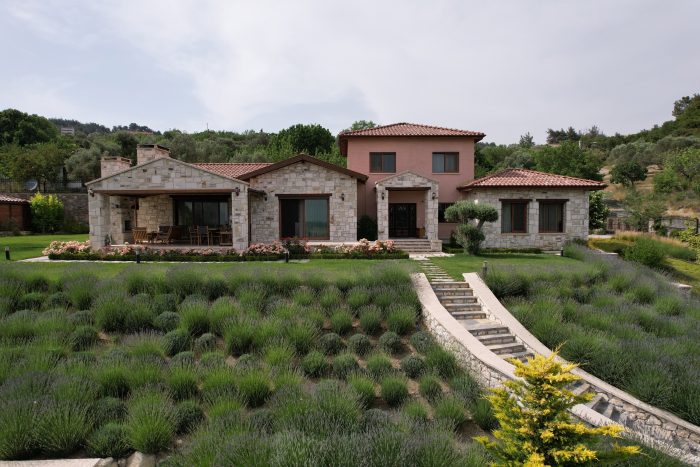
UK HOUSE by Ulema & Ulema Architecture
